
It divides all the processes into daily, weekly and monthly ones, explains the importance of each of them and discusses the conditions under which it becomes preferable to use warehouse cleaning services rather than overload the internal staff.
Warehouse Cleaning Checklist at a Glance
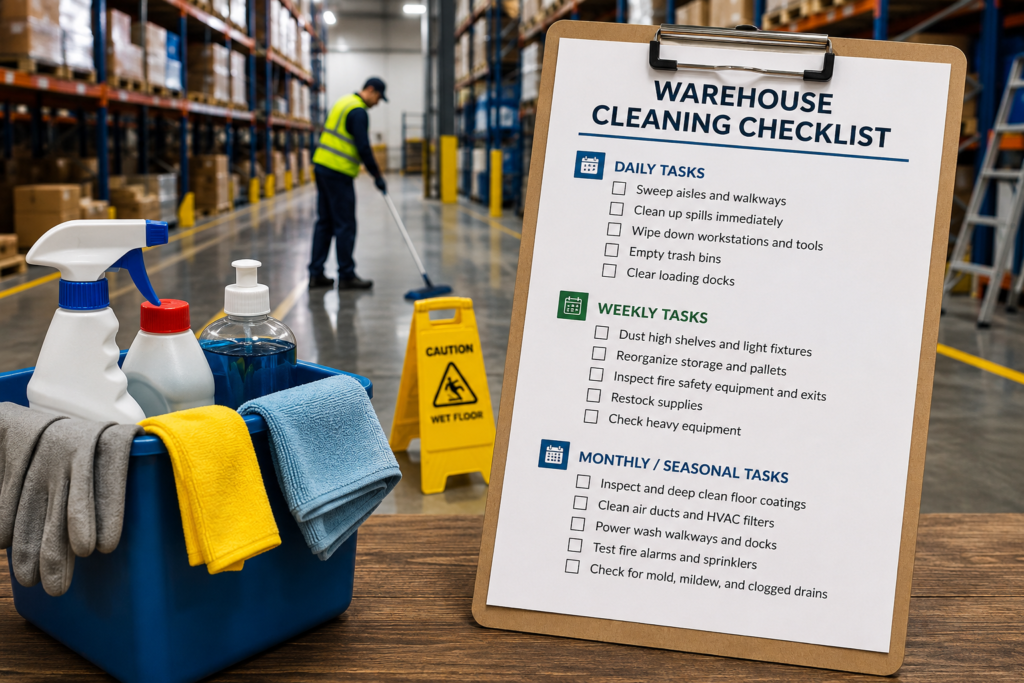
| Frequency | Key Tasks | Focus Area |
| Daily | Sweep aisles, clean up spills immediately, wipe down shared tools and workstations, empty trash bins, and clear loading docks. | Slip and fall prevention, general upkeep. |
| Weekly | Dust high shelving, ceilings, and light fixtures; reorganise storage and pallets; inspect fire safety equipment and exits; restock supplies; check heavy equipment. | Fire safety, storage organization |
| Monthly / Seasonal | Inspect and deep clean floor coatings; clean air ducts and HVAC filters; power wash walkways and docks; test fire alarms and sprinklers; check for mould, mildew, and clogged drains. | Facility maintenance, air quality, compliance |
Why a Warehouse Cleaning Checklist Matters
The warehouse environment is unique from other work environments since forklifts operate on the same floor as people do. Pallets are stored in stacks several feet high. There is a lot of mess – spilt liquids, open boxes, and dust from cardboard and shrink wrap – and the mess will never be noticed until there is a slip, trip, fall or equipment faults.
The use of a written warehouse cleaning checklist solves the problem of accountability. Every shift will have a clearly defined definition of “clean”. Moreover, having such a list helps to protect the business since nowadays insurance companies, auditors and even clients ask for documentation of the cleaning and maintenance schedule, and there is no better way to prove it than using a checklist.
Daily Warehouse Cleaning Tasks
Daily tasks are the ones that keep a facility usable and safe from one shift to the next. Skip them for even a day or two, and the backlog becomes visible fast.
Floors, Aisles, and Spills
All aisles and walkways must remain clean both at the start and at the end of each shift by focusing on those areas which become messy soon due to their proximity to the loading dock or the packaging area. All types of spills involving liquids, including water, oil, and cleaning solutions, need to be addressed right away. This single habit does more to prevent slip-and-fall injuries than almost anything else on a warehouse floor cleaning routine.
Workstations, Tools, and Waste
Shared equipment, scanners, packing tables, and break rooms must get wiped down each day, particularly in plants that operate on more than one shift schedule. The garbage containers must be dumped and lined again before they become overflowing, and the loading docks must be free from any kind of material.
Weekly Warehouse Cleaning Tasks
Weekly tasks catch what a daily sweep can’t reach, the dust and clutter that build up slowly enough to go unnoticed until they’re a problem.
Overhead and Storage Areas
Dust accumulates on high shelving, overhead beams, lighting fixtures, and doors that cannot be reached during routine cleaning. The weekly use of appropriate tools ensures that dust is not deposited on stock or blown into the air. It is important to conduct a weekly review of the organization of storage shelves and pallets, as it prevents potential hazards in terms of the stability of the latter.
Safety Equipment and Supplies
Fire extinguishers, emergency exits, and first-aid kits must be checked every week to ensure that everything is not obstructed, outdated, or missing. That is when cleaning and safety supplies will be replenished as well, since there would never be any excuse to skip any daily activities because of the lack of materials. Heavy machinery such as pallet jacks and conveyor systems must be examined weekly as well because a well-maintained machine is less likely to create any leaks.
Monthly and Seasonal Warehouse Maintenance
Monthly and seasonal tasks go deeper than routine tidying. This is where industrial warehouse cleaning shifts from surface-level upkeep to genuine facility maintenance.
Floor Coatings and Walkways
The flooring inside a warehouse is subjected to lots of stress due to forklift traffic, bulky pallets, and walking around all day long. It is wise to conduct an inspection every month to see if there is any cracking or damage to the flooring paint; a good clean or power washing of the pathways and loading dock flooring would help clear off the dirt that cannot be cleaned by routine sweeping.
Air Ducts and HVAC Filters
Dust, packaging fibres, and warehouse air are not a good combination for HVAC systems. Clogged filters make heating and cooling less efficient and push more particulate through the building. Duct cleaning and air duct cleaning should sit on a monthly-to-quarterly schedule depending on how dusty the operation is facilities handling raw materials, wood, or textiles typically need it more often than one storing sealed cartons. Beyond comfort, clean ducts matter for indoor air quality; the Canadian Centre for Occupational Health and Safety notes that poor ventilation and dust buildup are common contributors to indoor air quality complaints in industrial spaces, and it’s a straightforward problem to prevent with a regular filter and duct schedule.
Fire Systems and Moisture Checks
Testing of fire alarms and sprinklers should be done at least once per month as a minimum requirement, though more frequent testing may be required if required by local codes. This is also an opportunity to tour the facility and check for any signs of mould/mildew, moisture entry, etc. Moisture problems in a warehouse tend to start small and stay hidden until they’ve spread, which is why Health Canada’s guidance on identifying and addressing moisture and mould indoors recommends catching it at the visual-inspection stage rather than waiting for a stronger sign like a musty smell.
Industrial Warehouse Cleaning: Special Considerations
Risk profiles vary between warehouses. A cold storage warehouse faces issues with condensation and slipping that may never occur in a dry goods warehouse. A chemical warehouse will require employees who know how to handle and store chemicals safely rather than cleaning them. Canada’s Workplace Hazardous Materials Information System sets out clear rules for labelling, storing, and handling hazardous products, and the CCOHS overview of WHMIS requirements is a useful reference point for any facility that stores cleaning chemicals or industrial materials on site. Getting this right isn’t just a compliance box to tick — it directly affects how safely a cleaning crew can do their job.
Commercial vehicles, racking systems, and mezzanine levels each bring their own cleaning demands too. A checklist built for a small distribution centre won’t necessarily cover a multi-level facility with cold storage and hazardous material zones, which is why the best commercial warehouse cleaning programmes are built around the specific layout and workflow of the facility, not a generic template.
Building a Warehouse Sanitation Program That Sticks
A checklist only works if someone owns it. The facilities that stay consistently clean usually have one person or team responsible for confirming tasks are done, not just assigning them. Logging completed tasks, even in a simple sign-off sheet near the entrance, creates a paper trail that helps with audits and makes it obvious when a shift is falling behind.
Warehouse sanitation also benefits from matching the schedule to how the space is actually used. A facility running two shifts and heavy forklift traffic needs more frequent floor cleaning than one that operates a single shift with light foot traffic. Warehouse maintenance and cleaning should be reviewed every few months and adjusted as operations change; a new product line, added equipment, or a shift in storage needs can all change what the checklist should cover.
The training process is as important as the scheduling process. New employees should go through the checklist at the time of onboarding, rather than just reading the checklist and storing it away somewhere. Existing employees should have a quick review session each time there is a change in the checklist. An on-paper checklist in the supervisor’s office will easily be ignored, whereas hanging up the checklist near the break room or loading dock will be more beneficial.
When to Bring in Commercial Warehouse Cleaning Services
In-house personnel can take care of daily and weekly chores pretty effectively, yet in relation to monthly and seasonal jobs, inspections of floor coatings, duct cleaning, thorough power washing, and changing of the HVAC filters, the equipment and expertise needed to perform them are rarely available in warehouses. This is why using professional warehouse cleaning services is helpful because then the in-house staff can take care of routine maintenance, while the specialists deal with tasks requiring industrial equipment and expertise. Another good time to consider using such services is when onboarding a new warehouse, after a renovation, or before an audit.
Frequently Asked Questions
How often should a warehouse be cleaned?
Such activities as sweeping and cleaning up any spills must be performed daily, dusting off high places and checking equipment should be carried out once a week, while other activities such as duct cleaning and floor coating inspection must be done monthly or seasonally.
What is the biggest safety risk in an uncleaned warehouse?
Slips, trips, and falls are consistently among the most common injuries, usually caused by spills, cluttered aisles, or debris left in walkways rather than anything more complex.
Do warehouses need duct cleaning as often as offices?
In most cases, much more so. Due to the dust that emanates from packaging materials, pallets, and the movement of materials, there will be faster clogging of ducts and filters in HVAC systems, hence the need for more frequent inspection.
Can in-house staff handle all warehouse cleaning tasks?
Daily and weekly tasks are usually manageable in-house. Monthly and seasonal work like deep floor cleaning, duct cleaning, and power washing often needs professional equipment and is where most facilities bring in outside help.
What should a warehouse cleaning checklist include at minimum?
It will include cleaning of floors and aisles, spill cleanup, garbage pickup, dusting of storage and overhead areas, inspections of fire and safety equipment, and an inspection of the HVAC system and floors once a month.