The Hidden Costs of In-House Hospital Cleaning Staff
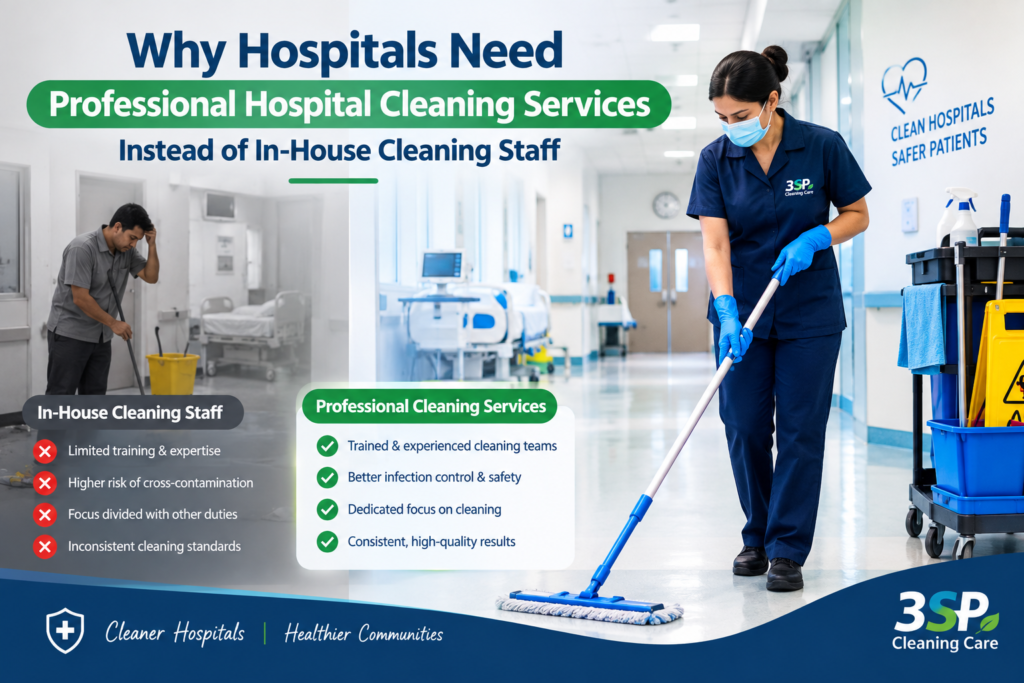
In-house cleaning for hospitals may seem the least costly option. This may be the case, but only when janitorial services stand as an independent cost centre. When janitorial services are the responsibility of the hospital, the burden of recruiting, vetting, training, providing for absences, purchasing custodial tools, and maintaining standards falls on the hospital’s own human resources and facilities teams. When a hospital in-house custodian quits or calls in sick, someone on hospital staff must disrupt their work to cover the custodial shift, often leading to a neglected hospital unit.
While the burden of cleaning in-house, or the costs associated with in-house systems, are not fully transparent in the hospital’s financial records, they are apparent in administrator hours and the additional burden placed on hospital staff. The costs are also seen in the variance of the standards of cleaning in the hospital. If a facilities manager is stretched thin by cleaning staff shortages, that facilities manager has the least amount of time to actually inspect the quality of cleaning services, which is the situation that hospitals can least afford.
Why Canadian Hospitals Are Choosing Professional Cleaning Services for Hospitals
Environmental cleaning also plays an important role in infection prevention as recommended by the Public Health Agency of Canada, Canadian hospitals gain many benefits through contracting professional cleaning services, including flexible staffing, reduced infection control training costs, advanced decontamination technology, improved regulatory compliance, and most importantly, the ability to redirect more resources toward patient care for better health outcomes.
Meeting Regulatory Compliance Without the Administrative Burden
Meeting Canadian hospital environmental cleaning demands is not optional. Provincial health authorities stipulate environmental cleaning, and accreditation bodies evaluate them. Internal teams spend a lot of time and effort meeting, monitoring, and managing cleaning standards. On the other hand, cleaning agencies that specialize in healthcare services build their operating framework on healthcare standards; therefore, hospitals clean to healthcare standards rather than chase them.
Specialized Training in Infection Control
Cleaning a hospital is much more complex than cleaning an office, and the consequences of an improper cleaning can be much more severe. The medical cleaning services and healthcare cleaning providers should align their practices with Infection Prevention and Control (IPAC) Canada guidelines. to their teams for cleaning terminals and other infection control deep cleaning procedures for isolation patient rooms, as well as for decontaminating contact surfaces for high-consequence pathogens. Obtaining the required infection control training for cleaning a hospital is a significant resource investment most hospitals cannot afford when compared to contracting a dedicated cleaning service.
Access to Advanced Equipment Without the Capital Cost
In today’s world, infection control requires more than basic tools. Serious healthcare cleaning services utilize more advanced equipment that allows them to effectively clean and decontaminate surfaces, such as electrostatic sprayers and UV-C decontamination equipment. These tools and their maintenance, as well as continual upgrading, come at a price that makes them not feasible for most in-house teams. However, outsourcing provides a cost-efficient solution for teams, as the upfront cost is now the responsibility of the cleaning service. This also ensures that the hospital is never stuck with obsolete equipment.
Resilience Against Staff Absences
A hospital cannot afford to close its doors to the public just because its cleaning staff has a large number of absences due to sickness. Professional cleaning services for hospitals can staff a larger cleaning personnel pool due to their business model and thus have the means to fill gaps created by absences and staff turnover. A hospital’s in-house cleaning team would not be able to afford a system like this due to budgetary constraints. Backup capacity is more important to maintaining a cleaning staff in peak seasons for sickness and increased patient volumes.
More Efficient Administration Means Better Patient Outcomes
Each hour spent by a facilities manager on hiring and scheduling janitors, as well as dealing with related HR issues, is an hour that is taken away from managing clinical operations. The administrative burden of janitorial services is eliminated when an outside firm is contracted to provide cleaning services. Staffing, training, and providing the necessary equipment and supplies are the responsibilities of the full-service cleaning provider. The shift in focus is of more importance over time than the cost difference associated with the two (in-house vs. contracted cleaning services) models.
The Importance of Specialized Cleaning: Medical Office vs. Hospital Cleaning
Distinguishing cleaning services provided to hospitals and general medical office cleaning services is important. Walk-in clinics, doctor and dental offices, and other medical facilities require thorough and often hygienic cleaning; however, hospitals present an entirely different risk. The cleaning of hospitals is a more involved process due to the volume and the more invasive nature of the procedures that are often carried out in addition to the greater risk of encountering drug resistant organisms. Hospital cleaning services include more frequent terminal cleans, lengthened disinfectant dwell times, and zone based cleaning and servicing of ICUs, Operating Rooms, and Isolation Rooms.
Healthcare Excellence Canada Services that clean medical offices and those that provide cleaning of hospitals should not be compared as the same level of service. A medical clinic that employs a general commercial cleaning service may never know the difference, however, a hospital that employs the same service is exposing itself to a level of risk of infection that is impossible to quantify.
Factors to Consider When Selecting Healthcare Cleaning Services
Many cleaning services claim to have healthcare cleaning expertise, but it’s important to do your due diligence before signing a contract.
Infection Control Handling and Ongoing Training
How does the service provider train and refresh their knowledge on infection control? If this only happens during their initial onboarding and not on a continual basis, you should not expect them to stay current on any changes or new threats that would require updates to infection control protocols.
Cleaning Standards for High-Risk Areas
What cleaning methods and equipment do they employ in high-risk areas? Do the cleaning products that they use meet the disinfectant standards set by the Canadian health authorities? Any service provider who relies on manual wiping for cleaning in an Intensive Care Unit or Operating Theatre is not able to manage the high risk of those environments.
Addressing Staffing Gaps
How do they manage their own staffing shortages? If they have no plan in place to address employee absence, you can expect to face the same difficulty that you sought to improve by outsourcing cleaning services. The primary reason to use a professional service is the assurance of staffing coverage. If that staffing coverage does not exist, you have not accomplished your goal by employing their services.
Verifiable Healthcare References
Provide examples of healthcare customer references. Nothing speaks to your capabilities more than your experience in the healthcare field. Any cleaning service that has experience and rave reviews in commercial office cleaning has not necessarily fulfilled the rigorous demands of cleaning in a healthcare setting.
Why 3SP Cleaning Care
3SP Cleaning Care offers a valuable solution for healthcare facilities across Canada that need a partner for cleaning services built around hospital cleaning standards. This offering fills the gap that standard hospital cleaning contracts cannot. 3SP Cleaning Care offers staffing and equipment solutions for infection control and cleaning as part of its hospital cleaning services. 3SP Cleaning Care offers cleaning services to hospitals that are built around the same standards and expectations of compliance and reliability that the facilities’ hospital teams require, so they have one less variable to manage. Unlike most hospital cleaning services, 3SP Cleaning Care is built to meet the needs of various hospital and healthcare environments when it comes to staffing, training, and equipment.
Conclusion
The model for having in-house cleaning staff is theoretically sound. However, the level of regulatory scrutiny, the risk of infection, and the pressure on staffing make it most hospitals’ in-house model for cleaning services fail to meet their cleaning standards. Professional hospital cleaning services are designed to absorb that complexity.
For hospital administrators who are considering the switch, the more pertinent concern becomes whether the in-house team is capable of meeting the demands of a hospital’s cleaning standards, rather than weighing the costs of outsourcing. Feel free to contact us.
Frequently Asked Questions
What’s the difference between hospital cleaning services and standard commercial cleaning?
Hospital cleaning services follow stricter infection control protocols, including terminal cleaning and pathogen-specific disinfection, that standard commercial cleaning doesn’t cover. Hospitals also require zone-based cleaning approaches for high-risk areas like ICUs and operating rooms.
Why do hospitals struggle to maintain in-house cleaning staff?
In-house teams face high turnover, absenteeism, and the ongoing cost of training and equipment upgrades. Covering shift gaps and keeping pace with changing compliance requirements also puts a strain on internal HR and facilities departments.
Are professional healthcare cleaning services more expensive than in-house staff?
Not necessarily, once hidden costs are factored in. In-house staffing carries recruitment, training, equipment, and administrative overhead that often exceeds what a specialized provider charges for the same coverage.
What equipment do professional hospital cleaning services use that in-house teams typically don’t?
Many professional providers use tools like electrostatic sprayers and UV-C decontamination devices, which improve pathogen reduction beyond manual cleaning. These tools require ongoing investment that’s harder to justify for a small in-house team.
How is medical office cleaning different from hospital cleaning?
Medical office cleaning covers hygienic, routine cleaning for lower-risk settings like clinics. Hospital cleaning involves higher-frequency terminal cleans, stricter disinfectant protocols, and zone-specific procedures suited to a much higher infection-risk environment.