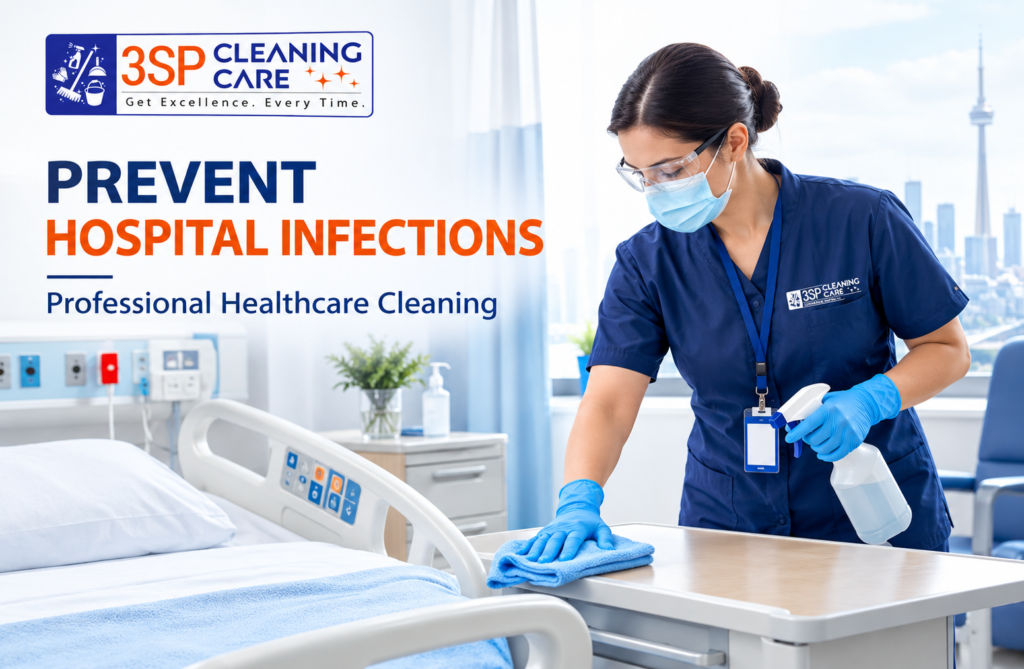
The purpose of this manual is to discuss hospital-acquired infections and their modes of transmission, as well as showing how healthcare cleaning helps prevent such infections.
What Are Hospital-Acquired Infections and Why Do They Matter?
The infection, which is also known as a nosocomial infection, is an infection, which is acquired while being under medical treatment in the hospital or other healthcare facilities, without being present at the time of admission. The terms which are used presently contain the term “healthcare-associated infection” because it occurs not only in hospitals but also in other organizations such as nursing homes. These infections lead to prolonged stays of patients in the hospital and make their recovery difficult.
The Public Health Agency of Canada notes that these infections can spread from person to person, including between patients, healthcare workers and visitors, and its healthcare infection prevention and control guidelines set the national foundation for stopping that spread. Canada also tracks the problem closely through the Canadian Nosocomial Infection Surveillance Program, a collaboration between the Public Health Agency of Canada, the Association of Medical Microbiology and Infectious Disease Canada and sentinel hospitals, which has been running since 1994.
Common Organisms Behind Healthcare-Associated Infections
There are certain organisms that cause a lot of worry to the infection control team, and they are MRSA (methicillin-resistant Staphylococcus aureus), C. difficile, VRE (vancomycin-resistant enterococci) and norovirus. The organisms mentioned above are very sturdy organisms, and they may survive for several days on bed rails, furniture and equipment even after the patient is moved out of the room.
How Germs Travel Between Patients
The majority of these environmental transmissions take place in a linear manner. The procedure includes contact with the contaminated surface, the transfer of the pathogens from the contaminated surface to hands or gloves, and finally hands coming into contact with the patient, equipment, or another surface. Hand hygiene interrupts this transmission process, but hand hygiene alone cannot prevent infection in the case of non-contact with the contaminated surface. It is the removal of the source by cleaning and disinfection that allows this.
3SP Cleaning Care recognizes this linear path of transmission and utilizes it at all healthcare facilities.
What Is Professional Healthcare Cleaning?
Professional cleaning in healthcare is an organized and evidence-informed process of cleaning and disinfection of the clinical environment. This is far beyond cleaning or general janitorial activities. Professional staff adhere to protocols which involve using appropriate disinfectants against specific microorganisms and surfaces and recording their actions. Environmental best practices for cleaning in Canada are provided by the provincial infection control agencies that explain the processes of cleaning and disinfection that decrease the microbial load to prevent its transmission to other individuals.
The professional quality cleaning services in hospitals also depend on the products used. The hard surface disinfectants available in Canada for hospitals are classified as drugs and require pre-marketing evaluation and a Drug Identification Number (DIN). That is why a professional team relies on Health Canada authorized disinfectants and follows the label directions for dilution, contact time and safe handling.
Cleaning and Disinfection Are Two Different Steps
Cleaning involves the removal of the soil and organic matter; on the other hand, disinfection entails killing or inactivating the microorganisms that may be left behind after cleaning. For a disinfectant to function properly, the surface must be clean; therefore, both processes are interrelated. Disinfection requires time as well since the surface must be visibly wet during the entire time required for contact, as indicated by the manufacturer.
Trained Staff and Documented Procedures
The cleaning of any professional medical facility needs individuals who have knowledge about the importance of all of these actions. Staff are taught about the procedures, additional safety measures, and correct use of personal protective equipment, as well as chemical substances and biohazardous waste. The employment of checklists and defined pathways guarantees standardization of the procedure in every single room and on every single shift.
Five Ways Professional Healthcare Cleaning Prevents Hospital-Acquired Infections
Taken together, the following five practices show how a well-run cleaning programme directly lowers infection risk.
1. Eliminating Resilient Pathogens
Organisms like MRSA, C. difficile spores, VRE, and norovirus are known to stay on surfaces for long periods, hence the need for disinfectants and not general cleaners. The professional staff opt for disinfectants that have proven effective against these organisms and prepare them in proper dilutions. In the case of C. difficile, most infection control staff prefer sporicidal chemicals that include chlorine-based disinfectants since regular disinfectants are ineffective in killing the spores.
2. Disinfecting High-Touch Surfaces
Light switches, door handles, call buttons, and bed rails harbour bacteria because there are many hand contacts on these surfaces. The daily and multi-daily procedures are meant for these surfaces to ensure contamination is not built up and transferred to hands.
| High-Touch Surface | Why It Carries Risk | Professional Cleaning Response |
| Bed rails and call buttons | Touched constantly by patients, staff and visitors | Scheduled disinfection during the day and again at discharge |
| Door handles and light switches | Shared by everyone moving between rooms | Included in every cleaning route, using a fresh cloth for each zone |
| Equipment surfaces and IV poles | Handled during care, then by the next clinician | Cleaned according to facility protocol and manufacturer guidance |
| Washroom fixtures and rails | High moisture and frequent contamination | Cleaned with dedicated cloths after the main room, following the clean-to-dirty order |
3. Using Systematic Cleaning Techniques
Methods are as important as outcomes. The cleaning is done from the cleanest spot to the dirtiest, from top to bottom, so that all the dirt and bacteria are allowed to drop onto the spots which have yet to be cleaned and not those which have been cleaned. Microfibre cloths and mop heads are replaced between rooms or zones, and those rooms where extra measures are taken to clean are generally left for last with proper protection on. The cleaning equipment is also cleaned and disinfected since a dirty cloth or bucket would just transfer contamination to another room.
4. Carrying Out Terminal Discharge Cleaning
After discharge or transfer of a patient from the room, there should be a deep cleaning of the room so that whatever the previous patient leaves behind, the subsequent patient should not take over. All the surfaces are cleaned and disinfected, including those which may escape the attention, for example, under-bed railings and edges of furniture. Most places today incorporate technology like ultraviolet-C (UV-C) light or hydrogen peroxide vapour to disinfect all hard-to-reach places where wiping may not be possible manually.
5. Verifying Results with More Than the Eye
While a room may appear immaculate, it could still be contaminated; therefore, successful programmes evaluate their effectiveness. Organizations that offer public health services in Canada’s hospitals also offer help in conducting audits for environmental cleaning, including audits of environmental marking. Different methodologies may be used, each having its own advantages and limitations.
| Verification Method | What It Shows | Main Limitation |
| Visual inspection | Whether a surface appears clean | Cannot detect microorganisms |
| Fluorescent gel markers | Whether a surface was actually wiped during cleaning | Does not measure the number of microbes |
| ATP bioluminescence meter | Amount of residual organic matter on a surface | Indirect measure that does not identify specific pathogens |
| Microbial culture | Presence of viable organisms | Slower and needs laboratory support |
Using these tools together gives infection prevention teams objective feedback, so they can coach cleaning staff with real results rather than assumptions.
Infection Control Cleaning Beyond the Patient Room
Infection control cleaning is not limited to the bed. The waiting room, hallways, nursing stations, bathrooms, staff room, and shared equipment are all involved in the transfer of organisms within a facility. Specialized units, such as operating rooms, ER, and isolation rooms, each require their own cleaning protocol due to their unique risks and requirements. In the event of an outbreak, the frequency of cleaning increases in cooperation with the infection prevention and control team of the facility.
This is true of all healthcare facilities, including hospitals, clinics, nursing homes, and specialized treatment centres. For this reason, the reliable healthcare facility cleaning company cooperates with the facility’s guidelines, rather than using a standardized one-size-fits-all approach.
What to Look for in Hospital Cleaning Services
Choosing a service provider for the cleaning of hospital premises can be seen as choosing an entity that prioritizes patient safety over aesthetics. A reliable service provider will be able to demonstrate the infection control training of its employees, procedures compliant with the standards of the Canadian guidelines, and safe handling of chemicals with proper information about their safety.
Also, one may expect an established audit system and open lines of communication with the infection control department of the facility. The employee screening process and proper supervision and scheduling of employees are signs of a responsible service provider.
The questions about verifying its results, responding to epidemics, and changing guidelines can reveal more about the quality of service than marketing.
Conclusion
There are many reasons why HAIs occur, and there isn’t any single approach to dealing with them successfully. But there is one element that can be influenced – the environment surrounding the patient. Professional cleaning eliminates persistent pathogens, maintains control over high-touch surfaces, adheres to precise techniques, resets rooms after each discharge, and objectively demonstrates the outcomes. When performed continuously by qualified personnel, it turns out to be one of the most reliable preventive layers in place.
When a facility is interested in developing such a programme, 3SP Cleaning Care offers professional cleaning in the field of healthcare tailored to prevent infections in Canadian healthcare organizations.
Frequently Asked Questions
What is professional healthcare cleaning?
Professional healthcare cleaning is a structured process of cleaning and disinfecting clinical spaces using trained staff, approved disinfectants, written procedures and documented checks to reduce the spread of infection.
How does cleaning reduce hospital acquired infections?
Cleaning and disinfection remove or destroy the microorganisms on surfaces and equipment, which cuts the chance that germs move from a contaminated surface to a patient through hands, gloves or devices.
How is hospital cleaning different from regular commercial cleaning?
Hospital cleaning uses disinfectants suited to specific pathogens, follows infection prevention protocols such as clean-to-dirty sequencing and contact times, and relies on trained staff and verification, while regular commercial cleaning mainly focuses on appearance and general hygiene.
How often should high-touch surfaces in healthcare facilities be cleaned?
The frequency is set by each facility’s infection prevention and control program based on risk, and high-touch surfaces in patient care areas are generally cleaned daily or several times a day, more often than low-touch surfaces.
How do facilities know that cleaning is actually effective?
Facilities combine visual checks with objective tools such as fluorescent gel markers, ATP bioluminescence meters and microbial cultures, because a surface that looks clean may still carry contamination.