If you are a concerned parent in Toronto or Vancouver who seeks to minimize exposure to harmful chemicals, an environmentally aware homeowner, or merely someone interested in non-toxic house cleaning, look no further. This guide offers everything that you seek regarding ingredients, room-by-room approaches to cleaning, and the answers to the questions Canadian families ask themselves when it comes to going green.
Benefits of Eco-Friendly Cleaning Tips for Canadian Families
According to Health Canada, families in Canada live indoors for about 90% of their time. This means that there is a need to examine what people are using on their floors and on other items inside homes that will eventually be released into the air that they breathe. Conventional cleaning materials use VOCs, phosphates, chlorine bleach, and artificial fragrances that cause problems like respiratory irritation, hormonal disturbances, and water pollution. These can be problematic, especially when children crawl on the newly mopped floors or use their faces on fresh pillow cases.
Use of natural cleaning products is a step towards minimizing your exposure to chemicals. It is also a way of reducing your carbon footprint since many of the conventional cleaning products flow into rivers through drainage systems.
Understanding Natural Cleaning Products: What Actually Works
The Core Ingredients of Green Cleaning
In order for green cleaning to work well, all that is required is just one thing, which is the availability of certain organic products in the house from the kitchen that can be ingested in the event that any unfortunate accident occurs. This is not mere rhetoric; this is a scientific truth.
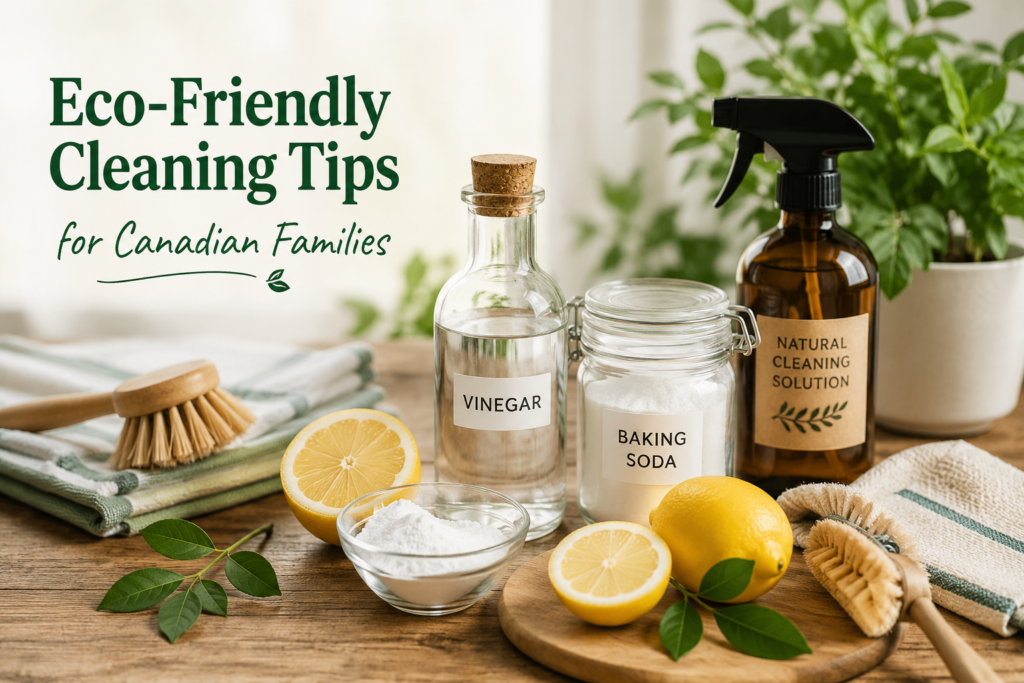
- White distilled vinegar: This is an acid that can dissolve fats and eliminate residues resulting from the Canadian hard water problem, as well as destroy most household microbes and fungi. It works best on glass, stainless steel, and tiles.
- Baking soda: This is a deodoriser as well as a mild abrasive material, which is used in stain elimination from grout, odour elimination from carpets and fridges, and fizzing cleaning along with vinegar within sinks and drainages.
- Castile soap: It refers to plant soap that is made of plant oils, for example, olive and coconut oil, and is a very good natural surfactant. Adding a few drops of water makes it useful in cleaning almost any area, including dishes.
- Hydrogen peroxide (3%): This is a natural antiseptic and a solution that turns into water and oxygen atoms after a while, leaving absolutely no harmful residue behind. This product is suitable for application onto any type of surface and is one of the best disinfectants that can be used for chopping boards and bathroom fixtures.
- Essential oils, such as tea tree, lavender, eucalyptus, and lemon, not only add a pleasant smell but also demonstrate antimicrobial effects (tea tree oil).
Choosing Commercial Natural Cleaning Products in Canada
Should you be the kind of person who really enjoys cooking with ready-made products, then Canada will definitely be your choice. Make sure to give preference to the products which have the EcoLogo certification, which is part of UL Environment, as this will mean that you have the Canadian eco-label. There are some manufacturers, including Nature Clean, Attitude, Bio-Vert and many other companies, that produce their goods in Canada without any phosphates, chlorine, or perfumes, and the packaging of all products is recyclable.
Room-by-Room Guide to Non-Toxic House Cleaning
Kitchen: The Heart of the Home
While the kitchen is the busiest place that gets the dirtiest, it is also the room that can be easily cleaned using eco-friendly products. In order to clean countertops, you need to make a mixture of white vinegar and water in a spray bottle in the ratio of one to one, with ten drops of lemon essential oil added in. It will serve as a surface sanitizer, grease cutter, and odor eliminator without emitting VOCs.
In case of greasy interiors of an oven, make a thick mixture of baking soda and water and apply it inside the appliance. After several hours, rinse it off with water mixed with some vinegar. This chemical reaction will loosen the grease much better than toxic commercial cleaners, which contain lye.
Cookware made of cast iron and stainless steel needs to be treated not with a soap solution but with a paste of salt and oil. Wood cutting boards are to be sanitized with hydrogen peroxide, left to stand for five minutes, and rinsed afterwards.
Bathroom: Deep Clean Without Harsh Chemicals
While the bathroom is where one would typically expect to use a chlorine-based product, there is no need for such an option since natural cleaning products canada can do the job just as effectively. The mixture of baking soda and castile soap used as a paste is effective when rubbed into toilet bowls, bathtubs, and sinks using a damp sponge. In order to clean the toilet properly, add half a cup of baking soda to the toilet bowl, pour half a cup of white vinegar over it, wait for ten minutes, and scrub before flushing.
For grout discolouration caused by mould growth due to the humidity created by hot showers in Canadian households, a paste made from hydrogen peroxide and baking soda will solve the problem easily without any dangerous fumes produced by chlorine bleach.
Using diluted vinegar and a squeegee is all that is needed to keep glass shower doors and mirrors free of stains.
Living Areas and Bedrooms: Sustainable Home Cleaning for Everyday Spaces
Sustainable home cleaning demonstrates that the Flooring made of either hardwood or laminate material can be cleaned using water combined with a few drops of castile soap and a little amount of vinegar poured into a bucket. The amount of moisture used should be as little as possible, considering the fact that Canadian winters are extremely dry, and wooden floors may have cracks because of too much moisture.
In case one wants to clean his/her carpet, all that he/she will need to do is spread some baking soda on it and leave it for at least half an hour, after which he or she vacuums the carpet. Since baking soda lacks any artificial odour, it is considered to be better than carpet powder, which includes an artificial scent.
Spot cleaning is quite easy; one only needs to use water, castile soap, and tea tree oil. Spraying the water-lavender solution on the fabric can help to remove any dust mites in case there are allergy sufferers in the family.
Building a Sustainable Home Cleaning Routine
Less is More: The Minimalist Cleaning Kit
Consolidation of cleaning products is one of the most significant actions that a Canadian family could take. Most families possess between fifteen and twenty cleaning products, which are often used to perform similar functions, leading to substantial use of plastics. In order to create an environmentally friendly household, one needs to purchase five items: multi-surface vinegar spray, concentrated castile soap, baking soda, hydrogen peroxide, and microfiber cloths.
There are two reasons why I chose to highlight the importance of microfiber cloths. First, microfiber cloths are designed in such a way that dust particles, dirt, and grease get stuck due to the effect of electrical charge on microfiber fibres. Second, most cleaning can be performed with water only, making it possible to do away with numerous paper towels. Microfiber cloths must be washed with cold water and no fabric softener.
Reducing Plastic: Refillable and Zero-Waste Options
The development of zero-waste cleaning products in Canada has been on an upward trend, especially in the country’s cities. Concentrated cleaning product refill stations can easily be found in independent grocers and specialized retail outlets in British Columbia, Ontario, and Quebec. The concentrates minimize the use of plastics because one can make several batches from just one concentrate tablet.
Dish bar soap, laundry soap nuts, and compostable cleaning cloths are becoming easily accessible in Canada, and it is easy to create zero-plastic waste habits using them.
When to Consider Professional Eco Cleaning Services
Nonetheless, there are situations where using professional cleaning is necessary; it may be moving, having a pregnancy or spring cleaning during a hard Canadian winter. As there has been growing consciousness regarding green cleaning services in Canada, many companies offering cleaning services provide green cleaning kits comprising only organic-certified cleaning materials, HEPA vacuum cleaners and microfiber technology.
An individual must know what products the cleaning service company is using and demand either certificates of the products offered or their ingredients. Any firm offering eco-friendly cleaning services will gladly provide these details to consumers. The best cleaning service companies to employ in Canada are those working under CIMS-GB projects.
Seasonal Eco-Friendly Cleaning Tips for Canadian Families
The significant change in seasons makes it necessary to create an environmentally aware cleaning schedule. Spring cleaning is a necessary tradition for good reasons – several months of salt, mud, and stale indoor air make spring cleaning very essential. Open the windows of your home the first time you get mild weather, and thoroughly clean the entrance and mudroom areas due to the accumulation of road salt, and also clean all heavy winter linens using a natural soap.
The summer months bring moisture to many parts of Eastern Canada, which is favourable for mould growth in basements and bathrooms. Ensure there is proper ventilation in the house, run dehumidifiers where necessary, and remove any mould found on surfaces using hydrogen peroxide instead of bleach.
Cleaning outdoor furniture in the fall, cleaning windows prior to sealing them, and cleaning the heating system, including vents and radiators, before winter is also recommended. A vinegar-soaked rag will help clean dust from vents. Eco cleaning services are very important in helping to reduce dust from heating systems and improve the air inside Canadians’ homes during the cold season.
Conclusion
Going green when it comes to cleaning is not an immediate process, nor should it be. Start small – focus on one room at a time, one do-it-yourself cleaning spray at a time, one changeover from regular products to natural products at a time – and go from there. What the cumulative effect of all those thousands of Canadian families doing the same thing will mean in terms of less waste polluting our landfills, less harmful substances leaching into our water, and less unhealthy air for our children is really something quite remarkable. Feel free to contact us.
Frequently Asked Questions
Q1: Are natural cleaning products as effective as conventional ones?
Yes, indeed, in the majority of cases of home cleaning chores, eco-friendly materials such as white vinegar, baking soda, castile soap, and hydrogen peroxide have proven their efficacy. It is true that their use demands a bit more time for dealing with stubborn spots; however, they prove to be as effective as commercial chemicals.
Q2: Are eco-friendly cleaning products more expensive in Canada?
Not necessarily. The cost of making homemade natural cleaning products is much lower than that of commercial products. The cost of natural commercial cleaning products is somewhat higher at the beginning, but ultimately, it will turn out to be cheaper.
Q3: Is white vinegar safe to use on all surfaces?
The following surfaces will not be harmed by the application of vinegar: glass, stainless steel, ceramic tiles, and countertops. Vinegar, which is acidic in nature, cannot be applied to natural stones like marble and granite, or materials such as cast iron and aluminium.
Q4: How do I find a reliable eco cleaning service in Canada?
It is best to look for businesses that are fully transparent about their product ingredients, have received certification by EcoLogo or Green Seal, and use a reusable microfiber system rather than disposable components. Seeking recommendations from satisfied customers through verified reviews is recommended.
Q5: What is the best all-purpose natural cleaner for Canadian families?
A simple mixture of one part white distilled vinegar, one part water, and ten to fifteen drops of tea tree or lemon essential oil in a reusable spray bottle is an excellent starting point. It handles counters, appliances, sinks, and bathroom fixtures safely and effectively.